
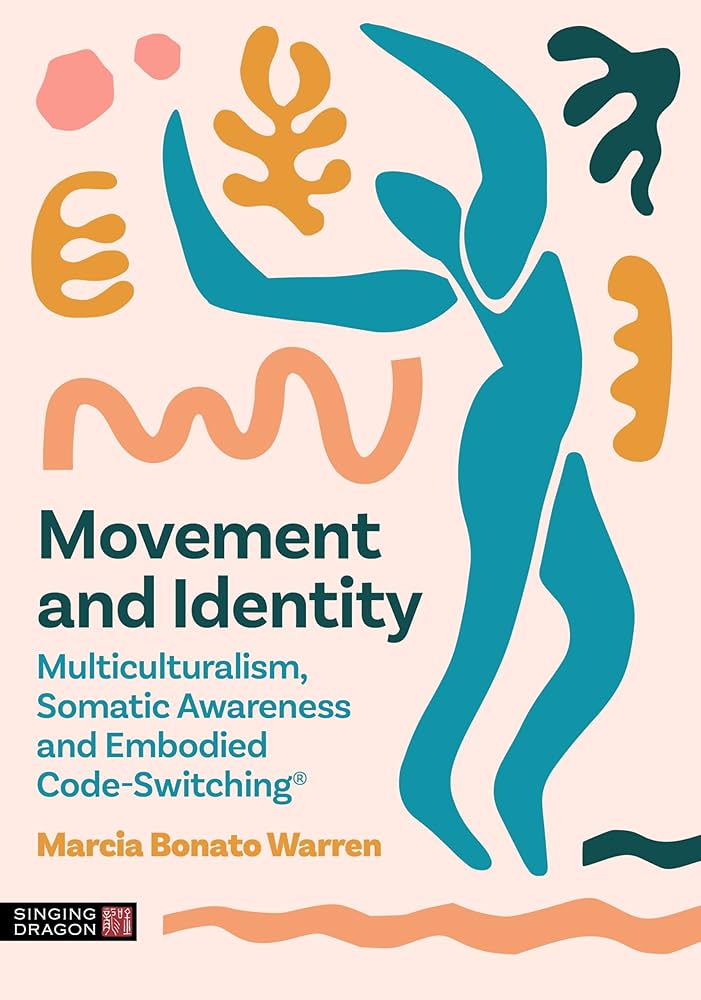
Title: Movement and Identity: Multiculturalism, Somatic Awareness and Embodied Code-Switching®
1 Basic Book Information
Title: Movement and Identity: Multiculturalism, Somatic Awareness and Embodied Code-Switching®
Author: Marcia Bonato Warren Publisher: Singing Dragon Release Year: March 21, 2025
Genre: Psychology & Cognition- Sports & Fitness Psychology / Anthropology / Self-Help
Pages: 297
ISBN: 978-1839978371
Target Audience: Readers interested in cognition, psychology, mindset and behaviour, therapists, body workers, fitness professionals, Pilates practitioners.
Overall comment: A critical read for anyone devoted to cultivating the mind as intensely as the body, and a rich exploration of how our movements reflect and express our cultural identities.
2 Overall Content and Structure
Movement and Identity: Multiculturalism, Somatic Awareness and Embodied Code-Switching®, by Bonato Warren, is a practical, hands-on guide. It combines theoretical foundations with concrete exercises designed to engage both the mind and the body, helping readers explore the many identities they carry within themselves. The book centers on multiculturalism, but because the general understanding of the concept of culture is broad, its insights are in fact relevant to everyone. In this sense, the book also functions as a self-help resource: it offers tools and techniques that foster self-awareness, nurture self-compassion, and support the discovery of personal insights and strengths.
At its core, the book explores the concept of identity, particularly identity in relation to movement, or identity as movement, how we embody these identities and how we can smoothly switch from one to the other. Here, movement is understood as nonverbal communication that occurs through time and space, both in and within the body and in the world surrounding the body. By reflecting on how movement can be encoded through a multiplicity of identities (within one, or across cultures), the readers are invited to grow and evolve.
Although the book can be read as a psychology or cognitive-training manual that is structured with rigor to help readers build mental and physical resilience, the author approaches this work with a deep sensitivity to human vulnerability, and merges elements of current contemplative tools into her practice. The book, in fact, engages some complex themes such as trauma, oppression, and social justice, yet always in a gentle, diplomatic, and non-intrusive way, guiding readers carefully through their own processes of growth. The author, Bonato Warren, steps into the narrative herself, sharing personal experiences to demonstrate how the material can be used. Her voice is warm and familiar, even punctuated by poetic interludes that lend the book its own distinctive identity, one that reflects her multicultural perspective. Because of this, the book stands apart from conventional psychology texts, contemplative practices, self-help manuals, or health and fitness guides. The author’s presence throughout the work conveys not only her professional understanding of the themes described but her personal connection to them, creating a sense that she is accompanying, rather than instructing, the reader, which fosters safety and connection.
The structure of the book mirrors the therapeutic frameworks it presents, in the sense that the techniques and tools described are a key for self-practice and for understanding each chapter. Furthermore, given its focus on movement, the book’s very architecture becomes a metaphor for a journey, which in itself is a multiculturally understood narrative strategy, which speaks for the inclusivity of the book.
The book is divided into four parts and seven chapters; the narrative unfolds like a path the reader travels along. Each part is a kind of ‘pit stop’ on this journey:
- Preparation – Part 1: Starting the Journey
- Exploring multiple terrains – Part 2: Travelling Our Inner Multicultural Landscape
- Encountering shaping forces along the way – Part 3: The Shaping Forces of Multicultural Identit
- Returning home – Part 4: Coming Home
In Part 1: Chapter 1: Preparing the Way
The author introduces the essential tools and techniques needed to embark on this mind-body journey. These include practices such as cultivating pauses, engaging with the breathing body, body scanning, exploring focused attention to several points; and a key technique, Bonato Warren calls: the Sensation-Interpretation-Action (SIA) Loop ( I sense, I feel, I do), which forms a core component of the Embodied Code-Switching® therapeutic approach that uniquely focuses on the body or embodied experiences, developed by the author.
In PART 2: Chapters 2 & 3: Moving Between Cultures and Finding Culture in Our Bodies
The author begins guiding the reader more actively through the journey and introduces the notions of culture and the ways we embody culture. Using evocative metaphorical imagery – for example, the iceberg of culture represented with its tangible/visible/verbal aspects on its peak and its intangible/invisible/non-verbal values underneath, the author explains how we all move between cultures and how cultures, in turn, move through us, shaping our habitual ways of being and moving in the world. The book helps the readers recognise these cultural ‘signatures’ or codes in themselves and others, with the end goal to foster greater awareness and acceptance of difference. The body is described not as a machine but a living system capable of perceiving itself, as a physical form, a vessel for action and energy, a carrier of identity, and a site of memory and awareness.
In PART 3: Chapters 4 & 5: The Presence of Power and Trauma in Our Many Cultural Bodies
The journey continues as the reader explores the forces shaping a multicultural, or multi-identity experience. The author describes the notion of power as both constructive and harmful, showing how power imbalances can create states of privilege or oppression within and around us. She argues that restoring balance requires conscious choice grounded in awareness. Trauma, which can also be associated to injury in the fitness world, is presented as the main disruptor of such power balance. Different forms of trauma, such as identity-based, intergenerational, developmental, and others, are explained with therapeutic clarity and at the same time, through spiritual consciousness, they are also metaphorically defined as ‘bad spirits’ that can unsettle our mental, physical, and energetic equilibrium. Multicultural individuals may carry layered traumas that only an embodied reconciliation of all of their identities can heal. Each culture offers its own healing pathways, and we all hold an innate one within ourselves. The readers are invited to explore which ones these may be.
Resilience is the key rebalancing force. To find such resilience, the author proposes a fundamental practice called ‘resourcing’, which involves identifying what is/feels ‘safe’ – safe places, supportive relationships, grounding emotions, or even imagined safe spaces.
In PART 4: chapters 6 & 7: Being Multicultural in a Multicultural World and Embodied Code-Switching®
In its closing chapters, the book reflects back on its core lessons, tools, and practices, guiding the readers toward a ‘neutral space’ where they can find grounding, strength, and a balanced integration of their many identities. It proposes that multiculturalism, or simply recognizing how multiple identities can live within us, can function as a superpower that enriches both the individual and the collective. Bonato Warren’s Embodied Code-Switching® method is presented as a therapeutic and contemplative tool for navigating and harmonising these layered identities through the body. In the end, we all carry a culturally shaped movement signature – we just may not yet recognise it.
3 Why does this Book Matter for the Pilates Community?
Although this book is not a Pilates or fitness manual, it examines many dimensions of fitness – movement, the mind, power, trauma or injury, and it links them all back to the body. It suggests that we all carry a cultural identity
(or many) that influence such dimensions, and by becoming aware of it, we can learn to ‘switch’ between the different identities within us. This awareness helps us find and strengthen our centre, which we could almost describe in Joseph Pilates’s words as our ‘girdle of strength’.
The book is an excellent training resource for Pilates instructors, both experienced and emerging, who wish to be inspired in their creative process of tailoring their programs or classes around a multiplicity of clients or students. It encourages, in fact, a deeper understanding of the multiplicities of bodies they work with daily, especially if they engage with clients or students from multiple cultural backgrounds or walks of life – a point that is particularly relevant in today’s increasingly global Pilates community.
This work is well-suited for Pilates practitioners tout court, be they trainers, students, or clients, who wish to enrich their fitness and Pilates self-practice. Much like the foundational principles of Pilates – breath, concentration, control, precision, centering and flow, this book aims at developing a somatic, mental and emotional awareness of our multiple identities and leads the readers through a disciplined process of focusing on the breath, cultivating pauses, engaging in precise, controlled mind-body exercises, oscillating the attention in and out of the body, to finally reach a balanced flow between such identities. It offers inspiration for both mental and physical training that can support general wellbeing as well as recovery and healing.
Furthermore, the author’s core therapeutic model seems to align with Joseph Pilates’ classical teaching modalities (verbal, visual, tactile, proprioceptive cueing, imagery). The book, in fact, guides the reader through the use of verbal, visual, haptic, imagery and proprioceptive tools, using a key technique as a form of ‘awareness in action’ (the SIA Loop). The author argues that somatic and mental awareness facilitate embodied code-switching. This switch takes place in a ‘third space’ which we may define, using contemporary Pilates terms a ‘neutral position’ of awareness, situated between our various identities, values, movements – a place from which we can reorient ourselves, reset and then …switch.
Ultimately, Bonato Warren’s book is about conscious movement through a flowing coordination of body, mind, and spirit … and isn’t this, at its core, the very essence of Pilates Contrology?
Book review written by PAA member Claudia Cialone.
NO AI TRAINING: Without in any way limiting the author’s – Claudia Cialone and publisher’s Pilates Association Australia – PAA, exclusive rights under copyright, any use of this publication to “train” generative artificial intelligence (AI) technologies to generate text is expressly prohibited. The author reserves all rights to license uses of this work for generative AI training and development of machine learning language models.
PAA Members – 20% discount off
This week’s book was generously supplied for review by Woodslane Health and is available to PAA members with 20% discount.
Woodslane Health is the local distributor in Australia for Handspring Publishing and Singing Dragon Publishers. Handspring and Singing Dragon publish a range of authoritative bodywork, manual therapy, and complementary health titles for professionals, trainers, teachers and general readers.
Woodslane Health are excited to offer PAA members a 20% discount across all their titles with free delivery for orders over $100.
PAA Members: Check under Resources in your membership area for the Woodslane Health discount code.
Comments are closed.