
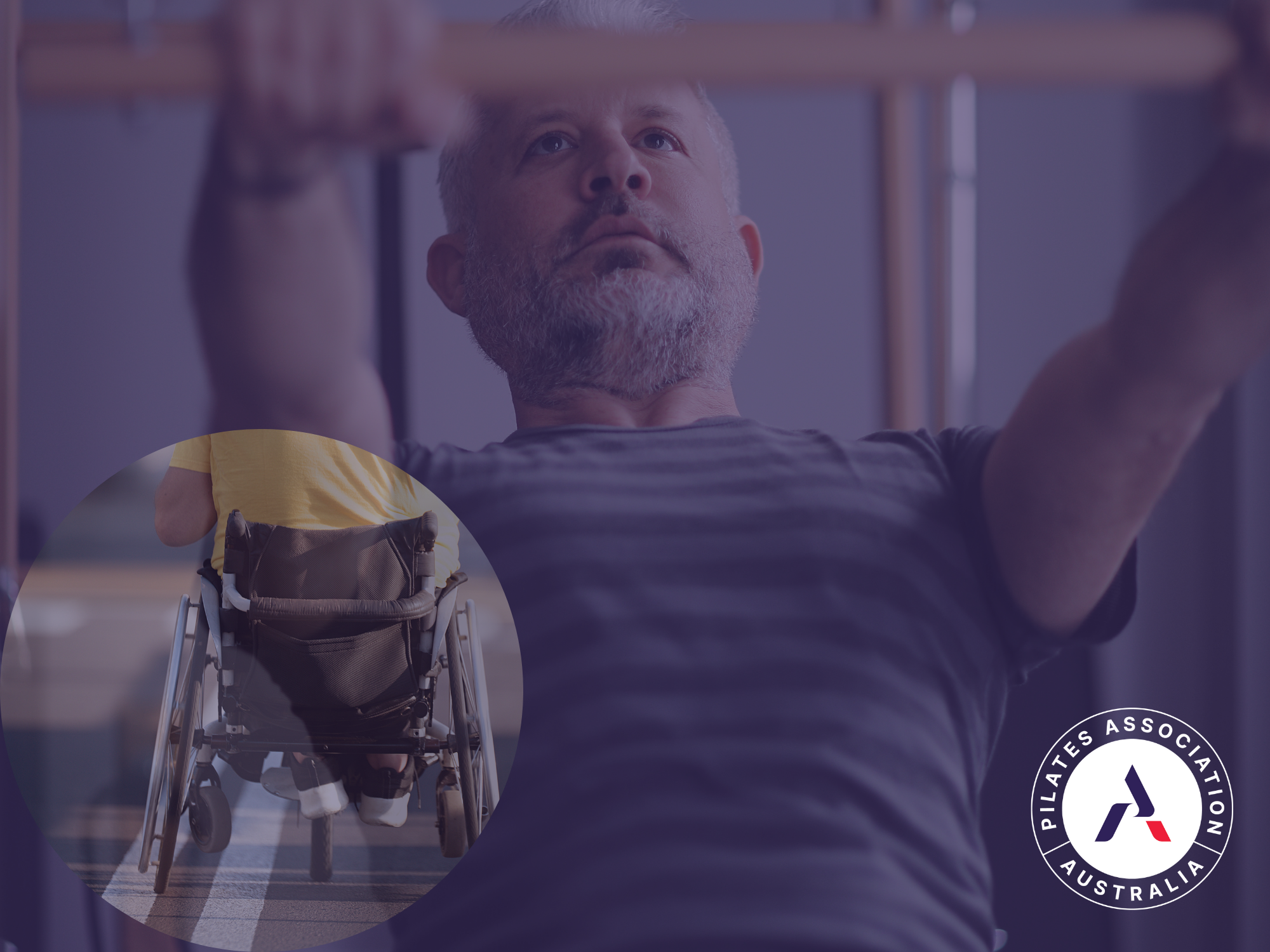
What High-Quality Research Really Shows
Pilates is increasingly recognised as a structured, adaptable and evidence-supported form of movement therapy for people living with disability. Far from being “just stretching,” well-designed Pilates programs function as progressive neuromuscular training—improving mobility, balance, fatigue, pain and quality of life.
This article summarises findings from randomised controlled trials (RCTs), systematic reviews, and meta-analyses only.
Why Pilates Works Well for People With Disabilities
Pilates emphasises precision, control, breathing and body awareness. Movements can be modified in supine, sitting, standing or wheelchairs, making it highly adaptable for neurological conditions, musculoskeletal disability, chronic pain and fatigue-related disorders.
Several systematic reviews evaluating Pilates for neurological and musculoskeletal conditions describe it as safe, feasible, and modifiable for different levels of disability [1,10,15].
- Neurological Conditions
Multiple Sclerosis (MS)
MS is the most researched disability group in the Pilates literature.
Balance, fatigue and sensory integration
A 10-week RCT of ambulatory adults with MS found that Pilates significantly improved sensory integration and reduced physical fatigue compared to traditional exercise [1]. Similar findings were observed in a related RCT showing improvements in balance under challenging sensory conditions [2].
Cognition and quality of life
An RCT comparing clinical Pilates to conventional exercise demonstrated significant gains in cognitive function and MS-related quality of life in the Pilates group [3].
Mobility and walking
A high-quality RCT by Guclu-Gunduz et al. showed that Pilates was safe and effectively improved walking capacity, mobility and fatigue over 12 weeks, with no adverse events reported [4].
Feasibility for wheelchair users
Qualitative and feasibility research shows Pilates is well-accepted by wheelchair-using individuals with MS, with positive impacts on wellbeing and movement confidence [5].
Summary: Multiple well-designed RCTs consistently show Pilates improves balance, fatigue, mobility, cognition and quality of life in people with MS.
- Stroke
Post-stroke disability commonly affects mobility, strength and balance.
A 2023 systematic review and meta-analysis of RCTs found moderate-quality evidence that Pilates improves static and dynamic balance after stroke, compared with usual care or conventional therapy [6].
The review also identified positive but lower-certainty evidence for gait improvements, cardiopulmonary endurance and quality of life.
Emerging trials also show online or home-based neuro-Pilates to be feasible and effective for chronic stroke survivors with mobility restrictions [7].
Summary: Research supports Pilates as a safe and moderately effective method for balance and mobility retraining following stroke.
- Parkinson’s Disease
Parkinson’s disease (PD) affects movement speed, balance, posture and falls risk.
Balance and functional mobility
In an RCT comparing Pilates to conventional physiotherapy, the Pilates group had greater improvements in balance and lower-limb strength [8].
Gait and motor control
A 12-week motor-learning-based Pilates RCT reported significant improvements in reaction time, functional mobility, balance and gait, with benefits maintained at three-month follow-up [9].
Falls risk reduction
A review of clinical Pilates in PD indicates consistent improvements in postural control and fall-related parameters, often outperforming traditional strengthening programs [10].
Summary: RCTs show Pilates improves balance, postural stability, gait and functional mobility in Parkinson’s disease.
- Cerebral Palsy (CP)
Evidence is mixed.
A well-designed RCT of ambulant children with CP found no clinically significant improvements in gait or trunk kinematics after a short Pilates program [11].
However, other small RCTs report improvements in balance and gross motor function when Pilates is added to conventional therapy [12].
Summary: Evidence is limited and inconsistent—Pilates is feasible for many children with CP, but optimal dosage and long-term effects are not well established.
- Musculoskeletal Disability and Chronic Pain
Many adults experience disability due to chronic musculoskeletal conditions.
Older adults with chronic pain
A 2022 systematic review found that Pilates significantly reduced back pain, neck pain and knee osteoarthritis symptoms, and improved quality of life in older adults [13].
Chronic low back pain
A large exercise network meta-analysis identified Pilates as one of the most effective interventions for pain and disability reduction, ranking above many conventional exercise approaches [14].
Extremity musculoskeletal conditions
A 2025 systematic review concluded that Pilates reduces pain and disability in upper- and lower-limb conditions, though the certainty of the evidence was low [15].
Summary: High-quality evidence supports Pilates as an effective intervention for pain, disability and function across many musculoskeletal conditions.
- Psychological Health, Fatigue & Participation
Many trials in MS, chronic pain and older adults report improvements in:
- Quality of life
- Cognitive function (especially in MS)
- Fatigue reduction
- Self-efficacy and movement confidence
Qualitative evidence highlights increased agency, enjoyment and participation in daily life when Pilates is tailored to the individual [5].
Safety & Accessibility
Across RCTs in MS, stroke, PD and musculoskeletal conditions, Pilates demonstrates a strong safety profile, with rare adverse events and high adherence rates [4,6,10,13].
Accessibility improves when programs are:
- supervised by instructors with disability-specific training
- personalised to fatigue levels, mobility aids, sensation and communication needs
- integrated into a person’s broader rehabilitation plan
What We Can Reliably Claim from High-Quality Research
Supported by evidence:
- Significant improvements in balance and mobility in MS, stroke and PD
- Reductions in fatigue (MS) and pain/disability (musculoskeletal conditions)
- Improvements in cognitive performance (MS)
- Positive effects on quality of life across multiple conditions
- Safe, adaptable and feasible for a wide range of disability levels
Less certain:
- Long-term community participation outcomes
- Optimal dosage for neurological conditions
- Clear, consistent benefits for cerebral palsy
Conclusion
The high-quality research base now supports what many clinicians and participants have observed for years: When taught by appropriately trained instructors and individually adapted, Pilates is a safe, flexible and effective movement therapy for many people living with disability. It is a powerful tool for building capacity, confidence and participation.
Robyn Rix, PAA President
References
- Kucuk F, et al. The Effects of Clinical Pilates Training on Balance, Sensory Interaction and Fatigue in People With Multiple Sclerosis: Randomized Controlled Trial. Multiple Sclerosis and Related Disorders. 2016.
- Guclu‐Gunduz A, et al. The Sensory Reweighting Effect of Pilates in Multiple Sclerosis: A Randomized Controlled Study. NeuroRehabilitation. 2017.
- Kucuk F, et al. Does Clinical Pilates Improve Cognitive Functions and Quality of Life in Multiple Sclerosis? NeuroRehabilitation. 2017.
- Guclu‐Gunduz A, et al. Impact of Pilates Exercise in Multiple Sclerosis Patients: A Randomized Controlled Trial. Clinical Rehabilitation. 2020.
- Barrett L, et al. Pilates for People With Multiple Sclerosis Who Use Wheelchairs: A Feasibility and Acceptability Study. Disability and Rehabilitation. 2022.
- Cronin S, et al. Effectiveness of Pilates Exercise on Balance and Function in Post-Stroke Individuals: Systematic Review and Meta-Analysis. Clinical Rehabilitation. 2023.
- Dibben C, et al. Feasibility and Effect of Remote Neuro-Pilates for People With Chronic Stroke. Journal of Stroke & Cerebrovascular Diseases. 2022.
- Mello M, et al. Clinical Pilates Versus Conventional Physiotherapy in Parkinson’s Disease: Randomized Controlled Trial. Journal of Bodywork & Movement Therapies. 2019.
- Donath L, et al. Motor-Learning-Based Pilates Improves Reaction Time, Balance and Functional Mobility in Parkinson’s Disease: An RCT. Journal of Aging and Physical Activity. 2023.
- Aibar-Almazán A, et al. Effectiveness of Pilates in Parkinson’s Disease: Systematic Review. Journal of Clinical Medicine. 2020.
- Katalinic OM, et al. Pilates-Based Exercises Do Not Improve Gait or Trunk Kinematics in Ambulatory Children With Cerebral Palsy: Randomized Controlled Trial. Clinical Rehabilitation. 2011.
- Abd-Elfattah HM, et al. Effect of Pilates Training in Children With Spastic Diplegic Cerebral Palsy. NeuroRehabilitation. 2015.
- Denham-Jones R, et al. Pilates for Chronic Musculoskeletal Pain in Older Adults: Systematic Review. Archives of Gerontology and Geriatrics. 2022.
- Hayden JA, et al. Exercise for Chronic Low Back Pain: Network Meta-Analysis of 118 Trials. British Journal of Sports Medicine. 2021.
- Gómez-Sánchez A, et al. Effectiveness of Pilates for Extremity Musculoskeletal Disorders: Systematic Review. Musculoskeletal Science and Practice. 2025.
Comments are closed.