
I’d like to begin by introducing myself. I’m a third-generation Classical Pilates instructor and the founder of MPG Pilates in Mandurah, Western Australia. It was through this work that I first met Julie Hammond, and later had the privilege of contributing to her book The Pelvic Diaphragm.
My earlier studies in Anatomy Trains had a big influence on how I see the body. As Pilates instructors, we’re trained to look beyond isolated parts and instead see patterns—how one restriction rarely exists on its own, but instead shows up through the whole system.
From that point of view, Pilates stops being a collection of exercises and becomes a way of organising the body as one integrated structure. Movement isn’t something we “add in”—it’s something that emerges when the system is working well.
Joseph Pilates called his work Contrology—a complete system of physical conditioning. And I think it’s important to say this clearly: the repertoire was never meant to be a menu of individual exercises. It’s a progressive system designed to restore full-body control.
Individual movements absolutely have value, but they don’t replace the intelligence of the whole method.
The Diaphragms as a Functional System
When I look at Joseph Pilates’ work, I keep coming back to one theme: balance through integration.
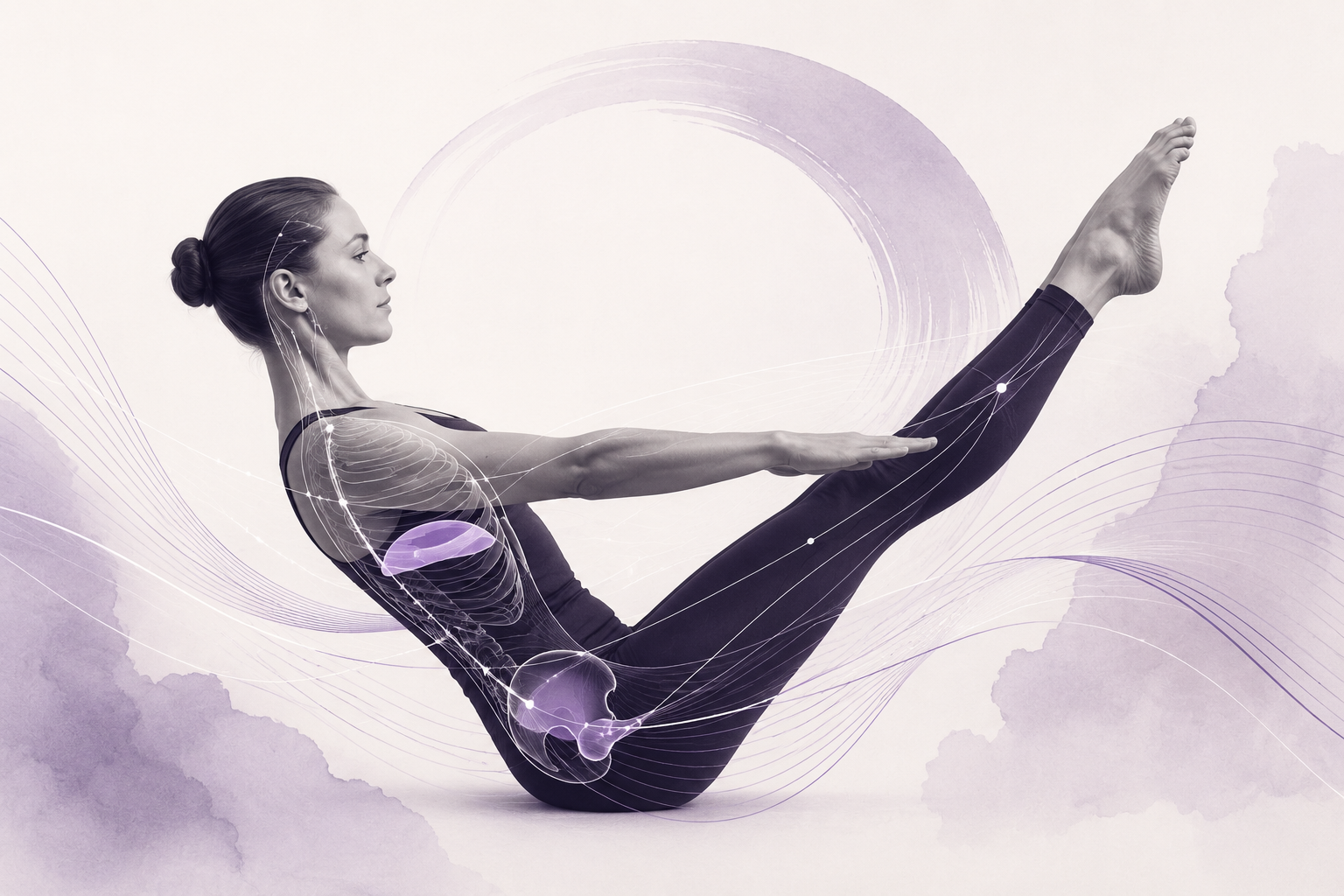
In particular, I see his system as deeply concerned with the relationship between the body’s diaphragms—the pelvic and respiratory systems—and how everything in between is influenced by that relationship.
The matwork is really the foundation of this. It gives us the clearest diagnostic picture of Contrology. It shows us where the body is organised, and just as importantly, where it compensates.
And I think this is part of why the apparatus evolved. When the matwork revealed something it couldn’t fully resolve, the equipment wasn’t an “add-on”—it was an extension of the system. A way of giving the body more information so it could reorganise itself more completely.
The Foot Corrector: Grounding the System
The Foot Corrector is a good place to start this conversation, especially because it was the first apparatus Joseph Pilates patented.
If we think of the foot as the body’s first point of contact with the ground, then it makes sense that it also becomes one of the first places we see global patterns show up.
What I find so interesting about this piece of equipment is how precise the feedback is. It doesn’t just tell you “strong or weak”—it shows you where weight is travelling, how pressure is distributed, and whether the system is organising or collapsing.
And very quickly, you start to see that the foot is never just about the foot. It’s about how the pelvis responds, how the spine adjusts, and how the whole system reorganises around load.
Breath as Diaphragmatic Training
Joseph Pilates said, “Above all, learn how to breathe correctly.” And I’ve always taken that as a very direct instruction, not a general suggestion.
The Breathaciser (Pinwheel) is one of the simplest ways I’ve found to observe this.
What I’m really interested in here is not just breathing mechanics, but the quality of exhalation—how completely the system can organise itself as air leaves the body, and whether the rib cage maintains its shape or collapses into itself.
Because what becomes obvious quite quickly is that breath is never just “in the chest.” It’s a whole-body event. The diaphragm doesn’t work in isolation, and neither does anything around it.
Reformer Work: Load, Breath, and Organisation
On the Reformer, exercises like Down Stretch and Elephant really highlight this relationship between breath, load, and organisation.
One asks the body to manage extension under spring tension. The other reverses that pattern entirely. But both rely on the same principle: that movement comes from a coordinated centre, not from isolated effort in the limbs or spine.
What the spring really does is remove the option to cheat. It gives feedback. It tells you immediately whether the body is organising from the right place or compensating somewhere else.
And in both cases, breath becomes part of that organisation—not something layered on top of movement, but something that shapes it.
The Spine Corrector: Expanding the System
The Spine Corrector is one of those pieces of equipment that looks simple until you actually work with it consistently.
What it really does is challenge the body to stay organised while the limbs move freely and the spine is supported in a very specific relationship to gravity.
And what I notice again and again is that if the diaphragms are not working in balance, it shows up immediately here—usually through the ribs, the pelvis, or the neck trying to take over.
When the system is working well, though, the movement feels expansive rather than forced. There’s a sense that everything is connected, but nothing is gripping to hold it together.
The Matwork: The Original Diagnostic System
For me, the matwork is still the clearest expression of Contrology.
Exercises like The Hundred and The Spine Stretch Forward show us everything we need to know about how the system is functioning—how breath is being managed, how load is distributed, and whether movement is truly integrated or being broken into parts.
The Hundred, in particular, is such a clear example of this. It demands organisation under rhythm, under fatigue, and under load. And it shows very quickly whether the centre is truly supporting movement or just holding on.
The Spine Stretch Forward then gives us the opposite lens—it shows where the back body is open, where it is restricted, and how movement is being initiated.
Together, they form a kind of conversation within the body.
The System as Integration
At its core, Pilates is not a series of exercises—it’s a system of integration.
It moves the body through flexion, extension, rotation, and lateral organisation, not as separate ideas, but as a continuous feedback loop between breath, load, and control.
When the method is practiced as a whole, the matwork becomes both conditioning and diagnosis. The apparatus then refines what the matwork reveals.
And I think this is where it all comes back to Contrology—because the goal was never isolated strength or flexibility. It was coordination. Integration. A body that can organise itself efficiently in space, under load, and through breath.
Balancing the diaphragms isn’t something we “do” to the body. It’s something that emerges when the system is working as a whole.
Sharon Michau, PAA Member and Committee Member
Comments are closed.