

Your website is often the first point of contact between you and potential clients. For Pilates practitioners in Australia, a professional website has become one of the most powerful tools you have for running a credible, compliant business that meets contemporary consumer expectations. Here’s an example.
With the Pilates Association Australia (PAA) actively working towards health fund rebates for therapeutic Pilates and the profession moving towards greater recognition and regulation, there has never been a better time to invest in the quality and professionalism of your online presence. This article explores what constitutes a professional website for Pilates practitioners in Australia, drawing on industry standards, consumer law requirements, and practical considerations.
Start with a Quick Website Audit
Before diving in, take five minutes to honestly rate your current website using this system:
🟢 Green: This is already done well
🟡 Amber: Partially there, but needs attention
🔴 Red: Not yet in place
● My credentials and PAA registration are clearly visible
● Clients can book and pay online without contacting me
● Pricing is clearly displayed
● My website has a Privacy Policy, T&Cs, and a disclaimer
● My site loads quickly and looks great on mobile
● My Google Business Profile is claimed and up to date
● My website and social media are connected effectively
Mostly green? Fantastic. A few reds or ambers? This article will help you know exactly where to focus.
1. Clear Professional Credentials and Registration
Prominently displaying your PAA membership level and membership badge, core Pilates qualifications, additional certifications, professional development, insurance status, and any other relevant registrations is a wonderful way to build immediate trust with potential clients.
The PAA Guidelines for using your membership badge on your website are available in the member portal under Resources.

Under the Australian Consumer Law (ACL), businesses are required to avoid misleading or deceptive conduct. Being transparent about your credentials protects both you and your clients, and for sole practitioners in particular, your qualifications are often the primary reason a client chooses you over someone else. Let them shine.
2. Online Booking Functionality
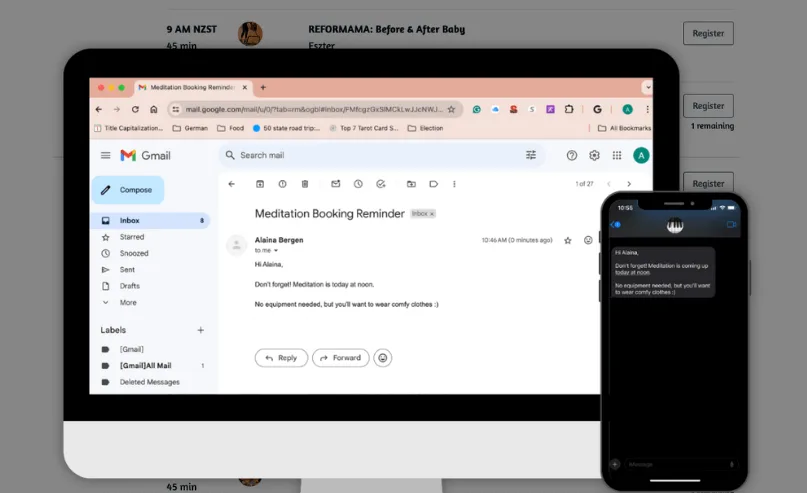
Offering seamless, reliable booking functionality is one of the best things you can do for your client experience and your own peace of mind. Clients today expect to book at 10pm on a Tuesday without having to send an email and wait for a reply.

For sole practitioners, automated booking and reminders can be especially freeing. It means fewer back-and-forth messages and more time doing what you love: teaching.
Under the ACL, if you accept pre-payments including class packages or vouchers, you are required to provide services within a reasonable time. A reliable booking system helps you manage capacity and clearly communicate booking policies, cancellation terms, and refund conditions at the point of purchase.
3. Transparent Pricing
Being upfront about your rates demonstrates confidence in the value you offer and helps pre-qualify clients before they ever contact you. Consider clearly displaying single session pricing, package options, membership rates, private versus group rates, introductory offers, and your cancellation policy.
For sole practitioners and small business owners, clear pricing also saves time and sets boundaries before a conversation even begins.
Under Australian Consumer Law, businesses are required to be transparent about all costs, with any additional fees disclosed before the client commits to purchase.
4. Legal Pages: What You Actually Need
Having the right legal pages in place is good professional housekeeping, and the requirements vary slightly depending on how you operate.
For all practitioners:
● Privacy Policy (required if you collect any personal information, which almost all websites do)
● Disclaimer (strongly recommended if you provide any health or fitness information)
For studios and practitioners with booking or payment functionality:
● Website Terms and Conditions
● Refund and Cancellation Policy (example)
What a disclaimer looks like in practice:
A suitable disclaimer for most Pilates practitioners might read something like:
“The information on this website is intended for general educational purposes only and is not a substitute for professional medical advice, diagnosis, or treatment. Participation in Pilates involves inherent physical risks. Please consult your doctor or a qualified health professional before beginning any exercise program. [Your name] is a qualified Pilates instructor and PAA member, not a physiotherapist or medical practitioner.”
Rather than copying legal pages from other websites, use Australian legal template services or consult a commercial lawyer who specialises in small business. A good starting point for understanding your privacy obligations is the Office of the Australian Information Commissioner, which offers free guidance on the Australian Privacy Principles.
5. Mobile Performance and Speed
More than 60% of web traffic comes from mobile devices, so ensuring your website works beautifully on phones and tablets is one of the most valuable things you can do.
You can test your own website right now using these free tools:
● Google PageSpeed Insights: Tests your site speed on both mobile and desktop and gives you a score with specific suggestions for improvement
● Google Search Console: Shows how your site is performing in search results, flags technical issues, and helps you understand how people are finding you
● Google’s Lighthouse: Quickly checks whether your site displays correctly on mobile devices
Aim for a load time of under three seconds. Most professional website builders handle these optimisations automatically, so you don’t need to be a tech expert to have a well-performing site.

6. The Client Journey: From Search to Booking
It helps to walk through your website the way a potential client would. Here is what that journey typically looks like, and where things can go wrong:
A potential client searches “Pilates [your suburb]” on Google. They find your website or Google Business Profile. They land on your homepage and within a few seconds decide whether to stay or leave. They look for your pricing, your qualifications, and what makes you different. They try to book or contact you. They receive a confirmation and feel confident they’ve made a good choice.
Drop-off most commonly happens at the search stage (if your local SEO isn’t working), the homepage (if it’s slow, confusing, or not mobile-friendly), the pricing stage (if they can’t find it), and the booking stage (if there’s no online option).
Walking through this process yourself on your phone every few months is one of the simplest and most revealing things you can do for your business.
7. Your Website and Social Media Working Together
Many sole practitioners build a strong Instagram following and assume that’s enough. But relying solely on social media to represent your business carries real risks: platforms change their algorithms, accounts get hacked, and you have no control over how your content is displayed or who sees it. Your website is the one online space you truly own.
The good news is that social media and your website work beautifully together when they’re connected intentionally. Use your Instagram, Facebook, or TikTok to build relationships and awareness, and treat your website as the destination where potential clients can learn more, check your credentials, and book with confidence.
A link-in-bio tool like Linktree or a simple dedicated landing page on your own website can act as an effective bridge. Rather than sending followers to a generic homepage, consider creating a simple page that includes your current class schedule or availability, a direct booking link, your most recent introductory offer, and links to your most useful content. This keeps the journey from social media to booking as short and frictionless as possible and keeps people on your own website rather than a third-party platform.

8. Professional Content and Brand Consistency
Your content communicates your professionalism just as much as your design does. For sole practitioners, this is a genuine opportunity to let your personality come through. Authentic images and a warm personal bio can be far more powerful than polished studio branding, because people often choose a sole practitioner precisely because they want that personal connection.
Investing in professional photography makes a real difference, but if budget is a consideration, a friend with a modern smartphone and good natural light can produce excellent results. Avoid generic stock photos of yoga or general fitness that don’t represent Pilates specifically.
Well-written content that’s free from errors, focused on client benefits, and consistent in tone builds trust. Consider having a professional editor review your copy or use a grammar tool like Hemingway App or Grammarly as a starting point.
9. Search Engine Visibility
Most Pilates clients search locally, so local SEO is where to focus. Claiming and optimising your Google Business Profile is one of the highest-impact, free things you can do. Sole practitioners can absolutely compete with larger studios here: a well-optimised profile and a handful of genuine client reviews can place you prominently in local search results.
Use the free tools mentioned in section 5 to understand how your site is currently performing and where to improve.
10. Budget Priorities: What to Focus on First
If you’re working with a limited budget, here is a practical way to think about where to invest:
Do first (low or no cost):
● Claim your Google Business Profile and keep it updated
● Use free tools to test and improve your site speed and mobile performance
● Add or update your legal pages using an affordable Australian template service
● Write a clear, warm bio and ensure your credentials are visible
Worth investing in when ready:
● Professional photography
● An integrated booking system that handles payments and reminders
● A professional email address using your own domain
Hidden costs to plan for:
● Domain name renewal (typically $20 to $80 per year for a .com.au, or $15 to $50 for a .com)
● Website hosting (varies widely, from $10 to $100+ per month depending on platform)
● SSL certificate for security (often included with hosting, but worth confirming)
● Stock photography subscriptions if you go that route
● Annual review of your legal pages as your business evolves
Conclusion
The digital front door of your Pilates practice matters. A professional website demonstrates your commitment to professional standards, supports compliance with Australian business law, and positions you as a qualified, trustworthy practitioner, whether you’re running a multi-instructor studio or building a solo practice from the ground up.
The encouraging news is that getting your website right doesn’t require a large budget or technical expertise. Start with your audit above, address any red or amber areas one at a time, and use the free tools available to track your progress.
As PAA members, our collective professional presentation strengthens the reputation of Pilates in Australia. If your website could use some attention, think of it as an investment not just in your business, but in the profession as a whole. Whether you choose an all-in-one platform like OfferingTree, work with a web developer, or upgrade your current setup, taking steps to improve your online presence is something to feel genuinely good about.
Katie Nissley
OfferingTree
About OfferingTree
OfferingTree is an all-in-one business management platform designed for Pilates and yoga professionals. OfferingTree streamlines your operations by enabling you to effortlessly build your website, manage scheduling and bookings, and utilise a robust marketing suite complete with email and text options, as well as automation features. Additionally, you can host on-demand video content, ensuring your offerings are always accessible to your clients.
Discount for PAA Members:
50% off the first 3 months of a monthly plan or 15% off the first year of an annual plan
7-day free or 14 days with credit card. Member discount is automatically applied after the free trial. To claim, see details in the PAA Member Portal under Resources/Member Benefits.
Comments are closed.