
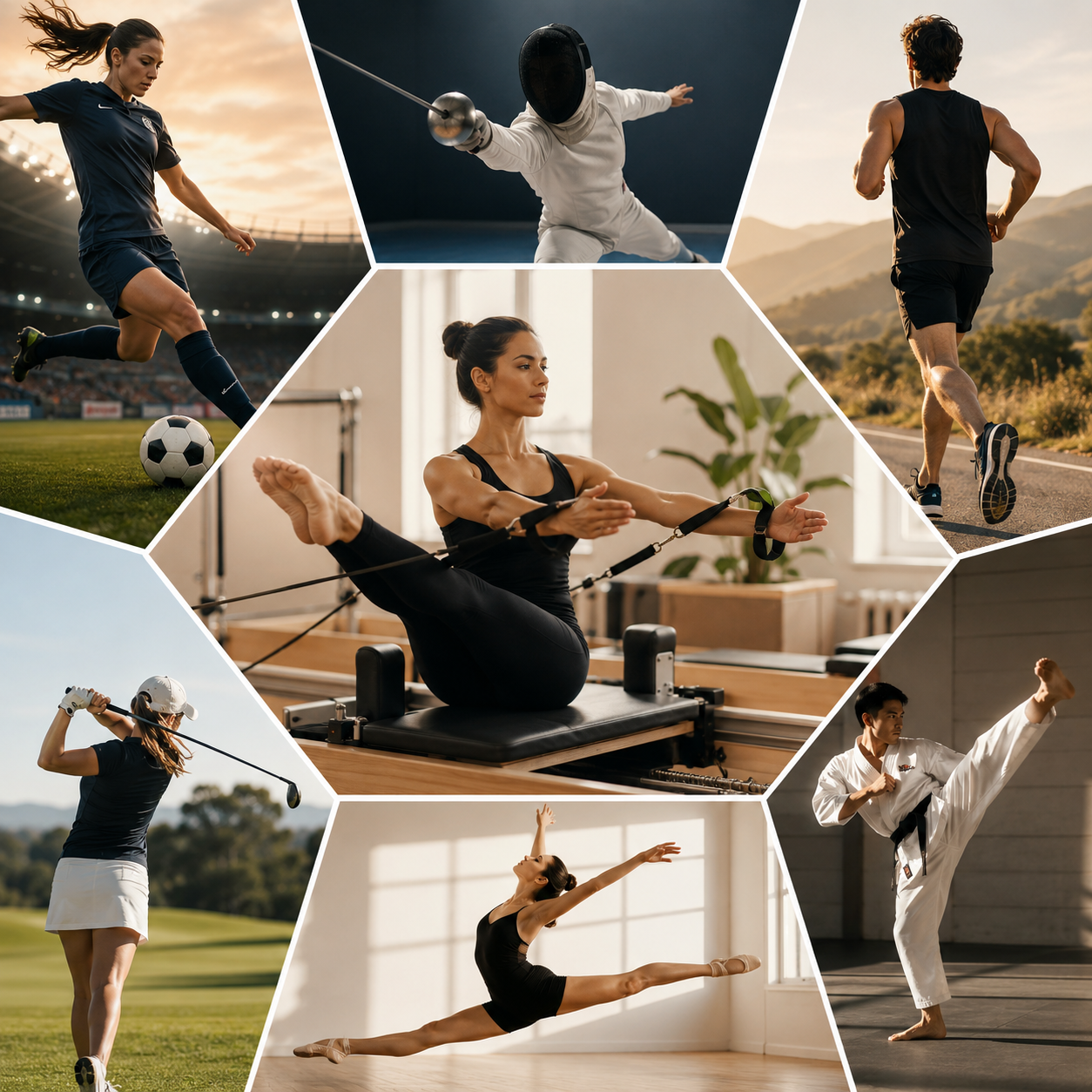
With the popularity of Pilates as an adjunct to sports-specific training among athletes, from footballers and runners to golfers and fencers, I wondered if the research supports the claims that Pilates improves strength, flexibility and body control.
There is definitely a growing body of scientific evidence suggesting that Pilates can enhance many of the physical qualities that underpin athletic performance, including dynamic balance, coordination, agility, movement efficiency and core strength. Research indicates that Pilates can help athletes move better, perform more efficiently and, in some cases, improve performance outcomes.
While dance is not universally classified as a sport, competitive dance disciplines involve many of the same physical and performance demands as sport and are frequently studied within sports science research.
Here are six areas where the evidence is compelling.
- Fencing: Building Balance and Lower-Limb Strength
One of the strongest recent studies comes from the sport of fencing.
Researchers investigating elite fencers found that a 12-week Pilates intervention significantly improved dynamic balance and lower-limb strength. Improvements in quadriceps strength were strongly associated with improvements in balance, suggesting that Pilates enhanced the athletes’ ability to generate force while maintaining stability.
For fencers, this is critical. Every lunge, retreat and directional change requires precise control of the body’s centre of mass. Better balance allows athletes to move more efficiently and react more quickly during competition.
A separate study comparing Pilates and yoga in female fencers also found improvements in dynamic balance and functional movement, further supporting Pilates as a valuable training tool for this sport.
- Soccer: Improving Agility and Movement Efficiency
Soccer players must accelerate, decelerate, jump, kick and change direction repeatedly throughout a match.
Recent research has demonstrated that Pilates can improve several physical qualities that are directly relevant to football performance. In a randomised controlled trial comparing mat and reformer Pilates programs, researchers found improvements in balance, agility, sprint performance, hopping performance and technical skills such as passing accuracy.
These benefits are thought to arise from improved neuromuscular control and more efficient force transfer through the trunk and lower limbs.
For footballers, Pilates may provide a valuable complement to traditional strength and conditioning programs by enhancing movement quality while reducing unnecessary energy expenditure.
- Running: Supporting Efficient Movement
Running performance is influenced by cardiovascular fitness, but efficient movement mechanics play a crucial role in both performance and injury prevention.
Pilates training targets several factors associated with running economy, including trunk stability, pelvic control and lower-limb alignment. Research has shown Pilates can improve core endurance, postural control and dynamic balance, all of which contribute to efficient movement patterns.
Although more sport-specific research is needed, the evidence suggests Pilates may help runners maintain technique under fatigue while reducing compensatory movement patterns that can contribute to injury.
For endurance athletes seeking a low-impact complement to their training, Pilates offers a practical way to develop strength and control without adding excessive training load.
- Dance: Enhancing Strength, Flexibility and Technical Performance
Dance is naturally aligned with Pilates. Both disciplines emphasise movement quality, body awareness, control and precision. Unsurprisingly, research has found significant benefits for dancers who incorporate Pilates into their training.
An 11-week Pilates program was shown to improve muscular strength and flexibility in dance students. More recently, a study investigating Latin dancers found that 12 weeks of Reformer Pilates training improved lower-limb strength, muscle activation patterns, joint movement efficiency and technical execution of dance movements.
These findings suggest Pilates can help dancers not only improve physical capacity but also enhance movement quality and technical performance.
- Golf: Improving Rotational Control and Swing Performance
Golf requires a unique combination of mobility, stability and rotational power.
An effective golf swing depends on the ability to transfer force efficiently through the body while maintaining control and balance. Pilates is particularly well suited to these demands because of its emphasis on trunk strength, spinal mobility and coordinated movement.
Recent research involving male golfers found that a four-week Pilates breathing training program significantly improved carry distance and ball speed. Researchers suggested that improvements in breathing mechanics and trunk function may have contributed to more efficient force production during the golf swing.
While the evidence base in golf is still developing, current findings suggest Pilates may provide measurable performance benefits for golfers seeking greater consistency and power.
- Combat and Racquet Sports: Training the Foundations of Performance
Although research in individual combat and racquet sports is still emerging, systematic reviews consistently report positive effects of Pilates on qualities that are central to these sports.
Athletes competing in martial arts, tennis and badminton rely heavily on balance, agility, coordination and efficient force transfer. Pilates has been shown to improve each of these physical capacities across athletic populations.
Whether an athlete is executing a taekwondo kick, returning a tennis serve or changing direction during a badminton rally, movement efficiency and body control are essential. Pilates appears to strengthen these foundations, helping athletes move with greater precision and confidence.
Why Pilates Works Across So Many Sports
Despite their differences, the sports highlighted in this article share several common physical requirements:
- Dynamic balance
- Core stability
- Agility
- Coordination
- Efficient force transfer
- Movement precision
- Postural control
These are the very qualities Pilates is designed to develop.
Unlike many training methods that focus on isolated muscles, Pilates trains the body as an integrated system. This whole-body approach may explain why athletes across such diverse sports continue to benefit from its practice.
The Bottom Line
The evidence supporting Pilates as a performance-enhancing training method continues to grow.
Current research suggests that Pilates can improve many of the physical capacities that underpin sporting success, particularly in fencing, soccer, running, dance, golf, combat sports and racquet sports, developing the balance, strength, control and movement efficiency that athletes need to perform at their best.
As the research base expands, Pilates is increasingly being recognised not only as a rehabilitation and fitness tool, but also as a valuable component of modern athletic performance training.
References
Amorim, T. P., Sousa, F. M., & Santos, J. A. R. (2011). Influence of Pilates training on muscular strength and flexibility in dancers. Motriz: Revista de Educação Física, 17(4), 660–666.
Choi, S.-A., Kim, H.-D., & Baek, C.-Y. (2026). Effects of a four-week Pilates breathing training program on golf performance in male golfers. Journal of Convergence Medical Science and Humanities, 30(1).
Kim, S., Kim, J., & Lee, H. (2024). Comparison of the effects of Pilates and yoga exercise on dynamic balance and functional movement in female fencers. Life, 14(5), 635.
Yılmaz, O., Kaplan, T., & Baťalík, L. (2025). Randomised controlled study on the effects of Pilates exercises in soccer: Comparing mat and reformer methods on physical and technical performance. PLOS ONE, 20(5), e0324129.
Yılmaz, O., Soylu, Y., Kaplan, T., & Taşkın, M. (2023). How Pilates exercises affect sports performance? A systematic review. Türk Fizyoterapi ve Rehabilitasyon Dergisi, 34(3), 367–373.
Yoon, J., Kim, J., et al. (2025). Twelve-week Pilates intervention improves dynamic balance by enhancing core and lower limb strength in elite fencers. Exercise Science, 34(1).
Zhang, X., et al. (2025). Effects of 12-week Pilates Reformer training on the biomechanics of Latin dance Cha-Cha circle chasing technique. Frontiers in Physiology, 16.
Comments are closed.